

The U.S. Army has taken delivery of its first Korean-made mobile tactical cannon less than a year after first issuing a solicitation, service officials said Thursday.
Speaking to reporters ahead of the Association of the United States Army’s annual meeting, the Army’s leader for offensive fires said that the mobile tactical cannon, made by Hanwha Defense USA, was on display at a first-of-its-kind “Army Modernization Day” held on Capitol Hill earlier this month.
“We’re excited to have that and get ready to test it,” said Brig. Gen. Robert J. “RJ” Mikesh Jr., portfolio management executive for offensive fires. “And get that soldier feedback, that we think is so important.”
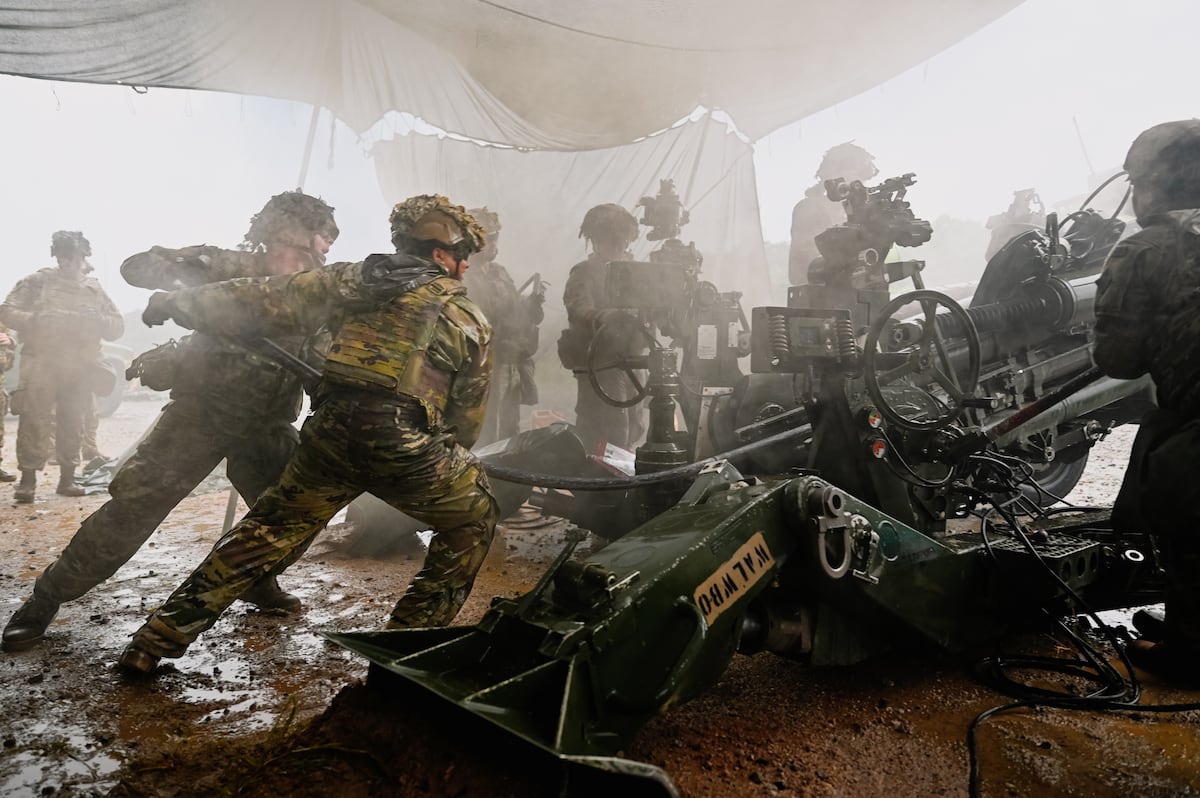
The Army in August announced it had entered a prototyping contract with Hanwha for the Mobile Tactical Cannon, a 155mm self-propelled howitzer intended to replace the legacy M777 155mm howitzers that have been in service since 2005.
The four-year contract, worth up to nearly $263 million, covers procurement of up to 18 of the systems for “rapid prototyping, testing, and Soldier experimentation,” the Army said in August. It calls for “accelerated delivery” of the first six system prototypes and allows the Army to execute options for up to a dozen more.
While the service hadn’t released full details about the testing regimen, officials said a series of operational experiments would take place to ensure the systems could perform reliably in “realistic combat conditions.”
The Mobile Tactical Cannon, which was contracted through an Other Transaction Authority agreement, is based on Hanwha’s K9 mobile howitzers, which have been employed by the South Korean military since 1999 and now have variants operating in 10 other countries, making up more than half of all self-propelled howitzers in service around the world.
The company announced at the time of the contract award that it was building an integration and test site in Opelika, Alabama, to develop and roll out the cannons.
“What enabled that was this close partnership under the PAE construct and trying new and novel ways of contracting,” Mikesh said Thursday. “In this case, we were not going after a clean-sheet design; we were looking for mature and available technologies. We opened our aperture for companies around the world, knowing that they’d have to onshore production within two years. That howitzer is now on contract.”
The Army has said in budget solicitations that its fielding effort for the new self-propelled howitzers will focus initially on Stryker Brigade Combat Teams, followed by Mobile and Infantry Brigade Combat Teams. And while the solicitation that received the Hanwha contract is for a wheeled self-propelled howitzer, the Army in late August published a new solicitation for a tracked variant of the Mobile Tactical Cannon. Hanwha officials told Breaking Defense they’re seeking to fill that requirement as well.
Army budget request documents for fiscal 2027 illuminate an additional testing role for the Mobile Tactical Cannon: It will facilitate work in the Army’s 155mm Artillery Propulsion Modernization project, designed to improve range and performance by pursuing novel propulsion technologies and advancements in “propelling charge, modular charge, ignition systems, propellant, and packaging solutions.”
“Solutions will be integrated into a system of systems capability to ensure interoperability, closing fires capability gaps to destroy or neutralize artillery targets out to 70 kilometers,” the document states.
The M777 has an effective range of under 24 kilometers, or about 15 miles, and up to 40 kilometers, or 25 miles, with the extended-range Excalibur round. The K9, a 52-caliber system, has a range of more than 60 kilometers, or about 37 miles.
Army leaders have said they want to field a ready version of the Mobile Tactical Cannon by 2031.